For years, businesses thought of search as one thing: Google.
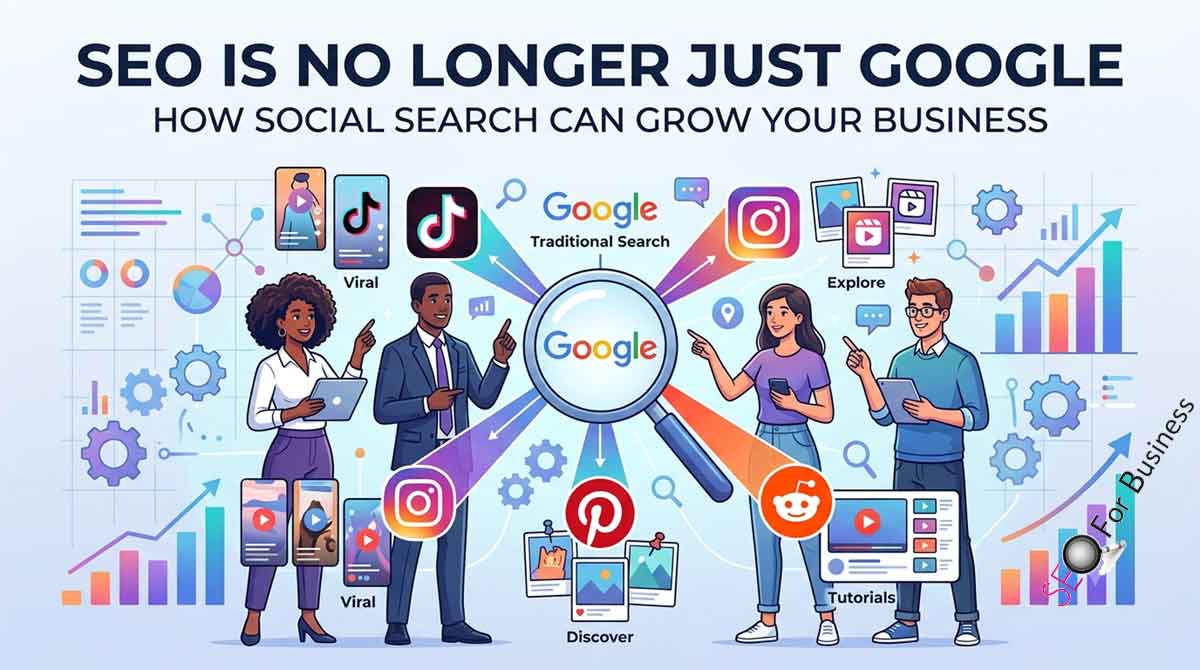
Today, customers discover businesses across Google, YouTube, Instagram, TikTok, Facebook, Reddit, and other platforms.
Social platforms are increasingly being used to search for products, reviews, recommendations, tutorials, local businesses, and ideas. Research from Sprout Social indicates that many consumers—particularly younger audiences—are beginning their discovery journeys on social platforms instead of traditional search engines.
That creates a major opportunity for businesses.
What Is Social Search?
Social search is the process of discovering information, brands, products, and services directly through social platforms.
Someone might search:
“Best roofers near me”
on Google.
But another customer may search:
“Roof replacement before and after”
on TikTok or Instagram.
Someone looking for a product might search YouTube for:
“Best laptop for business”
before visiting an ecommerce store.
The search behaviour is changing—and businesses need to be visible across these journeys.
Social Content Can Support Your SEO Strategy
SEO and social media should not operate as completely separate marketing channels.
Your keyword research can tell you what people want to know.
Your SEO content can provide the detailed answer.
Your social media content can turn that answer into short videos, images, carousels, posts, and discussions.
One piece of research can become an entire content campaign.
For example:
Keyword: Emergency Roof Repair
You could create:
- Google SEO service page
- Detailed roofing guide
- Instagram carousel
- TikTok/Reel
- YouTube video
- Customer FAQ
- Google Business Profile post
- Facebook post
- Short customer testimonial
One topic becomes multiple opportunities for discovery.
Optimize Social Content for Search
Social platforms increasingly use text, captions, spoken language, on-screen text, and other signals to understand what content is about.
That means businesses should think about discoverability when creating social content.
Use:
- Relevant keywords
- Clear captions
- Descriptive titles
- Useful on-screen text
- Natural spoken keywords
- Relevant hashtags
- Location information
- Strong profile descriptions
- Clear calls to action
Don’t stuff keywords.
Make the content genuinely useful first.
Video Is Becoming a Major Discovery Channel
Short-form video gives businesses a powerful way to demonstrate expertise.
A plumber can show a common plumbing problem.
A roofing company can show before-and-after projects.
An ecommerce company can demonstrate a product.
An SEO agency can explain how a Google update affects businesses.
This type of content builds visibility and trust simultaneously.
Don’t Forget Google Business Profile
For local businesses, social media should work alongside Google Business Profile and Google Maps optimization.
Your customers may discover your company through:
Google Search → Google Maps → Instagram → Website → Review
or:
TikTok → Website → Google Search → Google Business Profile → Contact
Modern marketing is increasingly a connected journey rather than a single channel.
Build a Multi-Channel Growth System
A strong digital marketing strategy can connect:
SEO + Google Business Profile + Social Media + Video + Content + Digital PR + Email + Paid Advertising
Each channel supports the others.
SEO captures existing search demand.
Social creates discovery and engagement.
Video demonstrates expertise.
Reviews build trust.
Digital PR strengthens authority.
Email helps turn visitors into returning customers.
The Modern Way to Grow Online
You don’t need to be everywhere.
You need to identify where your customers actually search and spend attention.
Then create useful content specifically for those platforms while keeping your website as the central destination for detailed information, enquiries, and conversions.
The future of digital marketing isn’t Google versus social media.
It’s building one connected online presence that customers can discover wherever they search.